Creative Audit Resourcing: How To Deal With Resourcing Challenges
On April 22, 2026, IIA Belgium convened the lead senior internal audit professionals from large Belgian organizations for an afternoon dedicated to one of the most urgent challenges in the profession: how to resource an internal audit function that is fit for the future. Three keynote presentations provided a rich combination of macro-economic context, corporate practice and public-sector innovation.
Setting the Scene: Why Resourcing Is Topping the Agenda
Olivier Elst, Partner at KPMG opened the session by framing the structural forces reshaping Internal Audit workforce planning. The combination of board-level expectations, accelerating technology disruption, cost pressure and a tightening labor market is creating a perfect storm for audit leaders. Key data points underlined the urgency:
- 92 million jobs are projected to be lost globally over the next five years, while 170 million new ones will be created — with knowledge workers, including auditors, most exposed.
- 49% of roles in Belgium will require significant up- or reskilling within five years (World Economic Forum, 2025).
- Continuous learning is a strategic imperative rather than an HR initiative.
Against this backdrop, Olivier introduced the concept of Strategic Workforce Planning (SWP) for Internal Audit: a structured approach to aligning talent supply with an evolving audit demand and taking into account automation, demographic shifts and the fact that for the first time in history five generations are now active in the workforce. In addition, Olivier outlined a spectrum of sourcing models — insourcing, co-sourcing and outsourcing — and emphasised that the right model depends on a function's specific risk profile, strategic ambitions and available budget. Selecting resources, he noted, requires attention to "hard" factors (competencies, certifications, sector expertise), "soft" factors (values, resilience, ambitions) and team dynamics (collaboration, diversity, psychological safety).
Audit Vlaanderen: Designing a Public-Sector Audit Function Fit for the Future
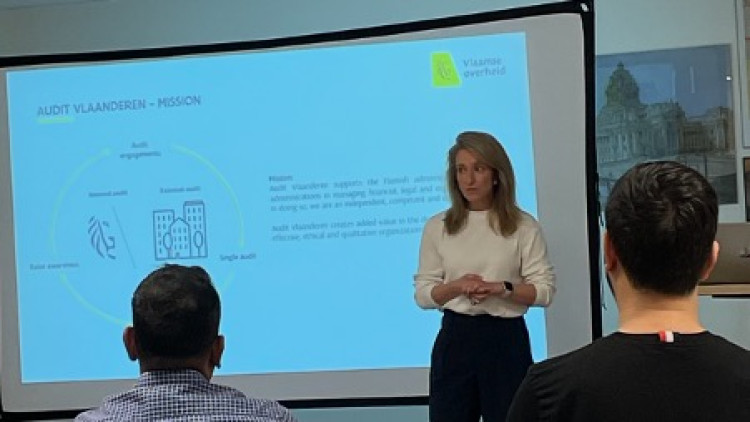
Patricia Van de Capelle, Manager-Auditor at Audit Vlaanderen, added to the session a perspective from Belgium's public sector. Audit Vlaanderen is the independent internal audit body for the Flemish administration and local municipalities, covering 44 government entities and about 800 municipalities with a combined annual revenue budget of €40 billion and €21 billion respectively.
The function's audit strategy is directly connected with the key societal challenges ranging from geopolitical uncertainty and the green transition to cybersecurity, demographic evolution and the digitalization of public services. This breadth of challenges demands a distinctive sourcing profile to attract internal auditors who combine a broad curiosity across government sectors with strong analytical skills, systems thinking and deeply held professional values.
Patricia presented Audit Vlaanderen's strategic co-sourcing model as its response. With an external resource budget of approximately €2 million per year, the function deliberately combines:
- T-shaped profile of its own auditors: a generalist core with knowledge depth in selected domains.
- Phased knowledge transfer: audit methodology and technical skills progressively absorbed from external partners.
- Specialist co-sourcing: external experts retained for highly technical or fast-evolving areas such as IT security.
- Access to leading practices and innovative audit techniques through long-term partnerships.
Patricia distilled the resourcing challenge into three imperatives: spot the right talent, hire for values not just skills, and align on partnerships. Structure, she concluded, must follow strategy — and strategy must follow society.
Internal Audit at UCB: Building a Lean, Digital and Agile Team
To complete the session, Thomas Debeys, Senior Vice President and Head of Global Internal Audit at UCB, brought a practitioner's perspective from a leading global biopharma company (revenue €7.74bn, operations in 36 countries). His nine-person team delivered about 54 audits in 2026 — a clear illustration that output is not simply a function of headcount.
Thomas organized his resourcing approach around a memorable four-part framework:
- Build: Hiring a dedicated Digital Audit Manager and upskilling existing team members on analytics and AI.
- Borrow: Leveraging IT colleagues for targeted support on audit projects requiring deep technical expertise.
- Buy: Co-sourcing niche skills — such as penetration testing and phishing simulations — from external specialists.
- Bot: Automating recurring analytics tasks to free up capacity for higher-value work.
On digital enablement, Thomas shared some real-life opportunities for automation : AI-assisted review of the audit universe and planning, AI-drafted Risk & Control Matrices, full-population testing, automated observation follow-up and improved report writing for non-native speakers. While AI offers significant productivity gains, he was candid that managing digital resources remains a challenge and that human review and critical sense are still pivotal in the audit approach.
To conclude, Thomas shared with the audience a standout initiative which is UCB's Guest Auditor Program — a structured three-week rotation program (one week of preparation, two weeks on-site) designed for identified high-potential employees from across the business. These high potential will operate for a certain time as full time auditors under the supervision of a UCB Internal Audit team member.
The benefits flow in all directions: guest auditors gain exposure to risk management and controls; the audit team acquires specialized domain knowledge; and UCB as a whole benefits from enhanced control awareness and a pipeline of future audit talent.
Key Takeaways
Across all three keynotes, several themes emerged with particular force:
- Strategic workforce planning is no longer optional. Audit functions that do not map future talent demand against projected supply risk being permanently understaffed/underqualified for the work that matters most.
- AI and digital tools are reshaping what auditors do — and therefore which profiles audit functions need to hire and develop.
- Creative resourcing models — guest auditors, targeted co-sourcing and alternatives for the classical sourcing, allow smaller teams to punch significantly above their weight.
- Values and culture are important selection criteria, not soft afterthoughts. The most effective teams are built on shared purpose, psychological safety and complementary strengths.
- Partnerships with external providers must be strategic and managed, rather than to be viewed as a transactional event.